Keep the original stake separate from the profit when translating a price.
A winning 100-unit bet returns 250 units. How much have you made? The answer is 150, because the other 100 was yours already. An odds converter has to preserve that distinction: decimal odds describe the whole return, while fractional and American odds express the profit relative to a stake.
Once those two amounts are separated, unfamiliar prices are easier to read. The sign, fraction or decimal changes; the underlying payout does not. All calculations here assume an ordinary cash bet, with the stake returned on a win and no fees or deductions.
Reading an American price
Let’s take an example from https://bettingpicks.net/: let’s start with the quoted price of -175. The minus sign means 175 units staked for every 100 units of profit. For a stake of 100, the profit is 100 × 100 ÷ 175 = 57.14; total return, 157.14. The decimal equivalent is 1.5714… .
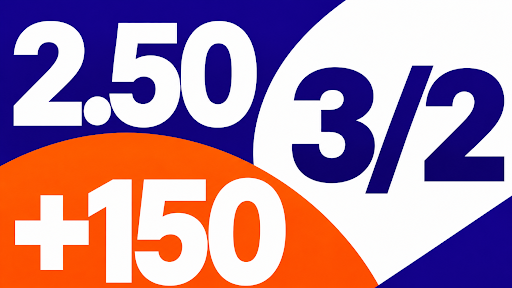
A positive price reverses the benchmark. At +150, 100 units staked earns 150 profit, with 250 returned altogether. That is the same payout as decimal 2.50 or fractional 3/2. The fraction means three units of profit for every two staked: 100 × 3 ÷ 2 = 150.
At -200, the winning profit on a 100-unit stake falls to 50. Add the stake back and the total is 150, equivalent to decimal 1.50 or fractional 1/2. A minus sign therefore does not mean a winning bet loses money. At -200, the potential profit is half the stake.
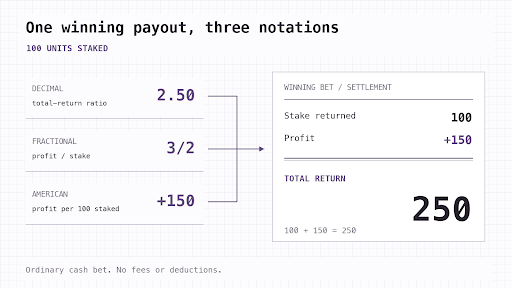
Three equivalent prices, one winning payout: 100 staked, 150 profit, 250 returned.
The 100-unit convention is a measuring scale, not a minimum bet. A ten-unit stake at +150 earns 15 profit; at -200, it earns five. Sporting News explains this positive-and-negative odds notation using the same benchmark. Actual stake limits are set separately by the bookmaker.
The odds converter formulas
Decimal odds are a convenient intermediate format because the payout calculation is direct: stake × decimal odds = total return. To find profit, subtract the stake. If a 20-unit bet wins at 2.75, the return is 55 and the profit is 35.
Decimal to fractional: subtract one, then express the answer as a fraction. For 2.75, the profit ratio is 1.75, or 7/4. For 1.80, it is 0.80, or 4/5. The subtraction removes the stake from the decimal return.
Fractional to decimal: divide the numerator by the denominator and add one. Thus 7/4 becomes 7 ÷ 4 + 1 = 2.75. This also explains a common slip: fractional 5/1 is decimal 6.00, not 5.00. The five describes profit; the extra one returns the stake.
Decimal to American: there are two cases. At decimal 2.00 or above, use (decimal − 1) × 100 and put a plus sign before the result. At 3.00, that gives +200. For decimal prices between 1.00 and 2.00, use −100 ÷ (decimal − 1). At 1.80, that gives -125.
American to decimal: for a positive number, divide by 100 and add one. A price of +180 becomes 2.80. For a negative number, divide 100 by its absolute value, then add one: -125 becomes 100 ÷ 125 + 1 = 1.80. Absolute value means ignoring the minus sign for that division.
Even money sits at the boundary: decimal 2.00, fractional 1/1 and American +100. Decimal 1.00 is outside these ordinary conversions; it offers no profit and makes the negative-American formula divide by zero.
Six prices to keep handy
| Decimal | Fractional | American | Implied probability |
| 1.50 | 1/2 | -200 | 66.67% |
| 1.91 | 91/100 | Approximately -109.89 | 52.36% |
| 2.00 | 1/1 | +100 | 50.00% |
| 2.50 | 3/2 | +150 | 40.00% |
| 3.00 | 2/1 | +200 | 33.33% |
| 5.00 | 4/1 | +400 | 20.00% |
The awkward row is 1.91. As an exact number, it converts to 91/100 and approximately -109.89. But a sportsbook displaying -110 may also show 1.91 after rounding: the underlying decimal is 1.909090… . Both displays can therefore be sensible without being exact mathematical equivalents.
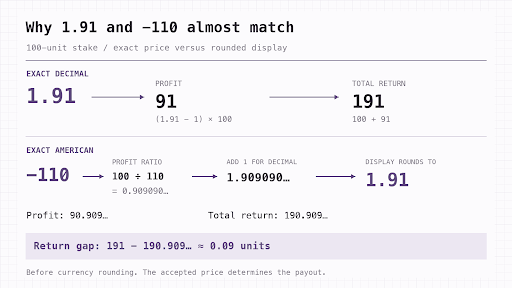
Exact conversion and display rounding are different operations. Retain the unrounded number until the final calculation.
The difference is small on a modest stake, but it explains apparent disagreements between calculators. At exact 1.91, a winning 100-unit bet returns 191. At exact -110, it returns approximately 190.91. The price accepted on the bet slip and the bookmaker’s settlement rules determine the actual payout.
A line is not a price
Numbers next to a selection can describe the result required rather than the amount paid. In our daily football tips, +2.5 and -3.5 denote goal-total selections. They are not American odds. Over 2.5 goals needs at least three goals; under 3.5 needs no more than three. The bookmaker’s price is a separate number.
The same distinction applies to “Team A -3.5 at -110” in basketball. The -3.5 is the handicap: Team A must win by four or more points. The -110 is the payout price. Feeding the handicap into a converter produces arithmetic for a bet nobody actually offered.
What the probability column means
Implied probability is 1 ÷ decimal odds, multiplied by 100 for a percentage. At 2.50, the result is 40%. That is the break-even win rate for equal-stake bets at that price, assuming no pushes, voids or extra costs.
It is not a measured chance of winning. Prices incorporate bookmaker margin. In a two-outcome market with both sides priced at 1.90, each implies about 52.63%; together they add up to 105.26%. Two mutually exclusive, exhaustive outcomes cannot both have those true probabilities.
A converter can translate the offered terms precisely. Deciding whether those terms are attractive needs a separate assessment of the event. A neat percentage on a screen does not supply that judgement.
Frequently asked questions
Which format gives the best payout?
None by itself. Exact equivalent prices pay the same amount for the same stake. Differences arise from the actual odds, rounding, fees or settlement terms, not the display format.
Must I stake 100 at American odds?
No. One hundred is the reference amount used to express the ratio. A smaller or larger permitted stake scales the profit proportionately.
Why does my calculator show more decimal places?
Some conversions repeat indefinitely, such as -110 becoming 1.909090… . A calculator may preserve more precision than a bookmaker’s display. Round only at the end of your calculation.
How can I check a conversion without another tool?
Calculate profit on the same stake in both formats. At decimal 1.80, a 100-unit stake earns 80. At -125, 100 × 100 ÷ 125 also gives 80. The matching results confirm the conversion.
18+ only. Follow local age restrictions. Gamble responsibly, set a spending limit and never chase losses.