The One Number That Proves Your Favourite Slot Machine Is Rigged
There is a single number, printed on or sitting behind every slot machine you have ever played, that settles the whole argument before you’ve put a coin in. Not which spin will land. Whether, over enough time, you can come out ahead at all. It’s the machine’s payback percentage — its return to player, or RTP — and once you understand what it actually says, the word “rigged” stops being a conspiracy theory and starts being a specification.
Here’s the part that trips everyone up, though, and it’s worth slowing down for. The spins themselves are not fixed. Each one is genuinely random, generated independently, and in regulated venues the software is tested and certified to prove it. And yet the machine is, in the only sense that counts, rigged. Both of those statements are true at the same moment, and the trick — the entire trick — is that they don’t contradict each other.
What the number actually says
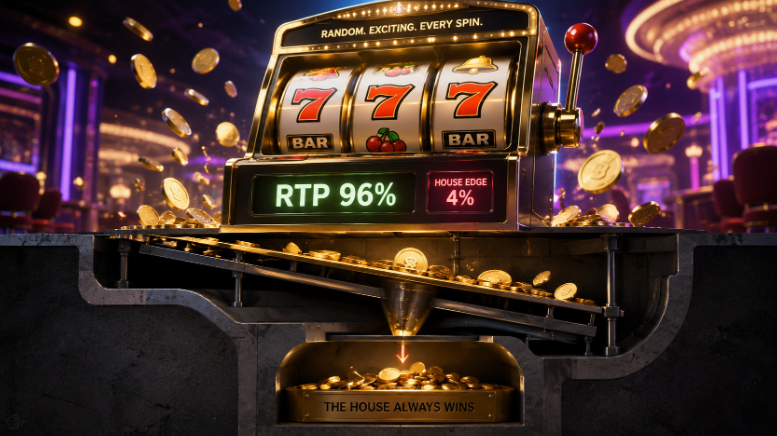
A slot advertised at 96% RTP is built to return 96 of every 100 units wagered through it over the long run, and to keep the other four. That’s not a glitch or a fix on any given pull; it’s the design target, certified before the game ever reaches the floor. Crucially, that percentage is an average across all players over enormous numbers of spins — not a promise that your hundred comes back as ninety-six.
Now ask the obvious question: where is the slot set to 100%, or 101%? It isn’t there. Practically no machine on a casino floor returns 100% or more, because that would mean the house paying you for the privilege of entertaining you. The number is always below 100. Always, by design, by certification, by the basic fact that someone has to pay for the building. That is the rig — not that any single spin is crooked, but that the aggregate is guaranteed, in writing, to drain one direction.
No, the machine isn’t “due”
The most expensive belief in the room is that a machine which hasn’t paid is “ready,” or that a hot one will stay hot. The random number generator has no memory. Each spin is independent of every spin before it, which means there is no such thing as due, owed, or warmed up. The 4% the machine is built to keep doesn’t accumulate somewhere with your name on it, waiting to be released. It’s a long-run average spread across thousands of players you’ll never meet. Your session is just noise inside someone else’s law of averages.
There’s no trick — and that isn’t the same as no point
Because the spins are truly random, there is no system, rhythm, or button-timing that beats the number. Anyone selling one is selling you the gambler’s version of a perpetual motion machine.
But “you can’t beat it” is not the same as “there’s no point,” and this is where the design gets clever rather than merely mathematical. A machine bleeding you at a steady 4% would feel like exactly what it is — a slow, boring loss — if you could see it clearly. So modern slots are built so that you can’t. Near-misses and “losses disguised as wins” — spins that pay back less than you staked but light up and chime as though you’d won — keep the experience feeling like near-constant almost-winning, while the number quietly does its work underneath. The rig isn’t hidden in the maths. It’s hidden behind the lights.
The myth that costs the most: that all slots are the same
If you take one practical thing from this, take this. Two machines sitting side by side, looking identical, can carry completely different numbers — one returning 97%, the next set far lower, with some venues running games down toward the high 80s. They feel the same to play. They are not the same to your wallet. The gap between them is the difference between losing slowly enough to enjoy an evening and losing fast enough to fund the casino’s car park.
Players obsess over themes, paylines, and which seat feels lucky, and ignore the only specification that actually determines how long their money survives.
So can you win?
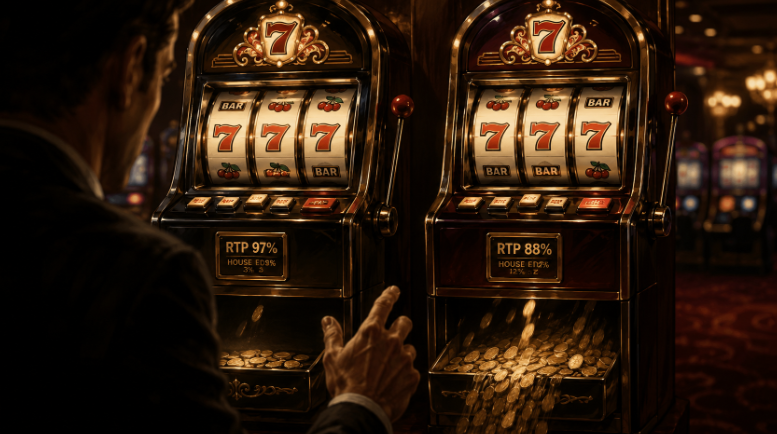
Honestly? No — not if winning means beating the number, because the number cannot be beaten. But if winning means giving your money the longest possible life and the fairest shot at the variance you’re paying for, then there is exactly one lever, and it’s the number itself. You can’t change a machine’s RTP. You can choose a higher one.
That’s the entire unglamorous truth behind how to win at slots: you find the machines built to take the least, and you play those instead of the ones dressed up to look more exciting. It is the closest thing to an edge the game permits, and it costs nothing but the discipline to check a figure before you sit down.
The rig was never hidden
The number isn’t a secret. It’s published, certified, and almost universally ignored — and that, more than the maths, is the casino’s real advantage. The house isn’t betting that you can’t understand the odds. The odds are public. It’s betting that you won’t read the one figure that explains all of them.
So read it. Find the highest one in the room, and play that. It won’t make you a winner — nothing on that floor will — but it’s the single move the game was ever actually willing to let you make.