Football News: How AI and Modern Analytics Improve Match Predictions
When broadcasters quote expected-goals figures before kick-off, they rely on a data stack that barely existed a decade ago, and specialist football news desks now track how those models perform week by week across leagues and tournaments. AI football systems and modern match analytics do not eliminate surprise results, but they reduce guesswork by turning live tracking, event logs, and historical patterns into measurable probabilities.
How AI Football Tools Are Changing Match Analytics
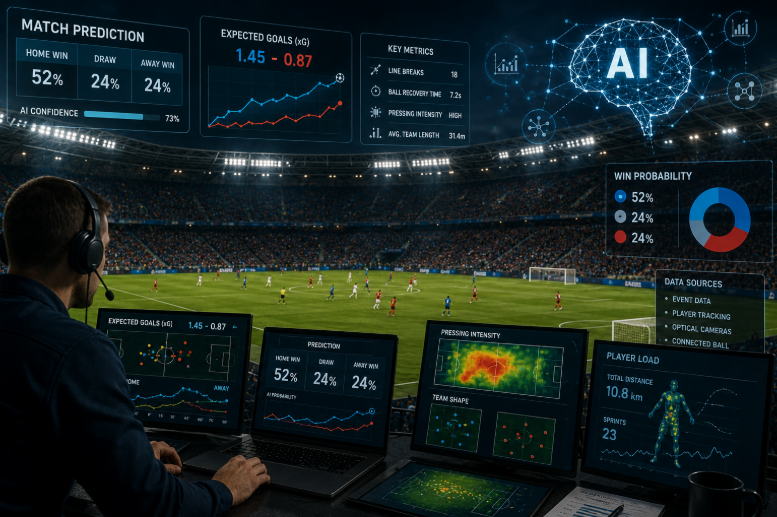
Football analysis used to depend on basic counts — shots, fouls, corners — that told only part of the story. FIFA’s Enhanced Football Intelligence (EFI) model changed that by merging two live streams: on-ball events and player tracking data. According to FIFA’s EFI framework, algorithms combine both sources so analysts know where every player stands when a pass, press, or shot occurs.
That integration powers metrics such as:
- Line breaks — passes that bypass defensive lines
- Ball recovery time — average seconds to win possession back
- Pressing intensity — how quickly defenders close space
- Team shape — line height and squad length in and out of possession
For match analytics teams, these inputs replace subjective impressions with repeatable measurements. A side can dominate possession yet lose if recovery time is slow or line breaks allowed are high. AI football pipelines process those signals faster than manual review, which is why major broadcasters and federation platforms now publish EFI-style graphics during live matches.
Football Statistics That Feed Better Predictions
Modern football statistics go beyond box-score numbers. Predictive models typically weight:
- Shot quality — location, body part, defensive pressure
- Phase control — time in possession, out of possession, and set-play phases
- Player load — distance covered, sprint frequency, pressing actions
- Contextual normalization — minutes played and team possession share
At the 2026 World Cup, FIFA will extend this through the FIFA Power Rankings, which score outfield players on attacking, creativity, and defending using EFI algorithms. Data is normalized by playing time and possession, then aggregated into automated post-match scores — giving predictive models a consistent player-level baseline across different match contexts.
Predictive Models and Data Analysis in Match Forecasting
Predictive models rarely rely on a single variable. Most combine event data, tracking feeds, and team ratings to estimate win, draw, and loss probabilities. UEFA’s competition infrastructure shows how federations operationalize this at scale: at EURO 2024, the FTECH hub collected optical camera data, connected ball signals, and electronic performance tracking before distributing it to analysis portals.
According to UEFA’s official technology briefing for EURO 2024, ten stadium cameras tracked 29 body points per player, while connected ball technology identified contact points in real time. The same data analysis pipelines feed tactical reports used by technical observers and coaching staff.
For public match predictions, workflows usually follow four steps:
- Ingestion — live events and tracking from official providers
- Feature engineering — xG, pressing sequences, set-piece frequency
- Model calibration — training on historical results with home advantage and rotation
- Output review — human analysts check outliers, injuries, and weather
FIFA’s Football AI Pro, announced ahead of World Cup 2026, applies generative AI to federation-owned data points to produce pre- and post-match insights in text, video, and visual formats. All 48 finalists will access the same validated intelligence base.
Where Analytics Helps — and Where It Still Falls Short
Data analysis improves prediction accuracy most when sample sizes are large and styles are stable. Cup ties with rotation, red cards, or penalty shootouts inject noise that algorithms underweight.
Analytics also struggle with late squad changes, motivation shifts in dead-rubber fixtures, and tactical surprises not seen in recent datasets. Even so, analysts who blend EFI-style football statistics with scouting reports typically produce sharper pre-match probabilities than either method alone.
Conclusion
AI football and modern match analytics have moved predictions from headline hunches toward structured probability. Enhanced tracking data, federation-grade football statistics, and automated predictive models now shape how fans, media, and teams read fixtures before the first whistle. The game will always produce upsets, but the reasoning behind a forecast is clearer and more evidence-based than at any previous point in the sport’s history.